Description
T10 Synchronous Belt 120-7050mm, 10mm 10/15/20/25/30/40/50mm CR, Automation Supplier
What Is a T10 Synchronous Belt?
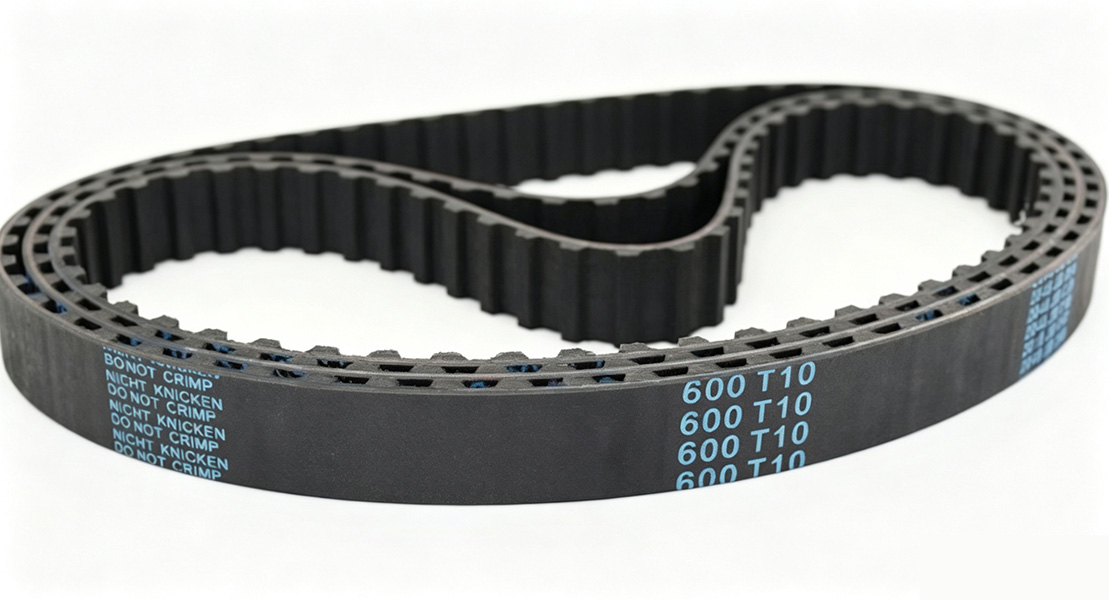
The T10 synchronous belt (also called the T10 timing belt) is a metric-standard trapezoidal-tooth timing belt built around an exact 10 mm tooth pitch. Power is transmitted by positive engagement between the belt teeth and the matching pulley grooves, so the drive runs without slip, without lubrication and without any variation in speed.
Because the 10 mm metric pitch carries a larger tooth cross-section than imperial-pitch belts of similar width, the T10 synchronous belt offers high torque capacity in a compact drive package. It is widely specified for medium-to-heavy duty power transmission where accurate positioning and repeatable motion are essential.
A T10 belt transmits power from several hundred watts up to several hundred kilowatts, reaches a transmission efficiency of 98% or more, supports speed ratios up to 1:10, and permits linear speeds up to 35 m/s. It is equally suitable for multi-shaft drives, where a single belt drives several pulleys at once.
The T10 synchronous belt requires no lubrication, produces no slip and no contamination, and runs quietly. Its dynamic flexing performance and crack resistance are excellent, and it also offers outstanding ozone resistance together with ageing, heat and wear resistance, which keeps drives reliable in demanding industrial environments.
Materials & Construction
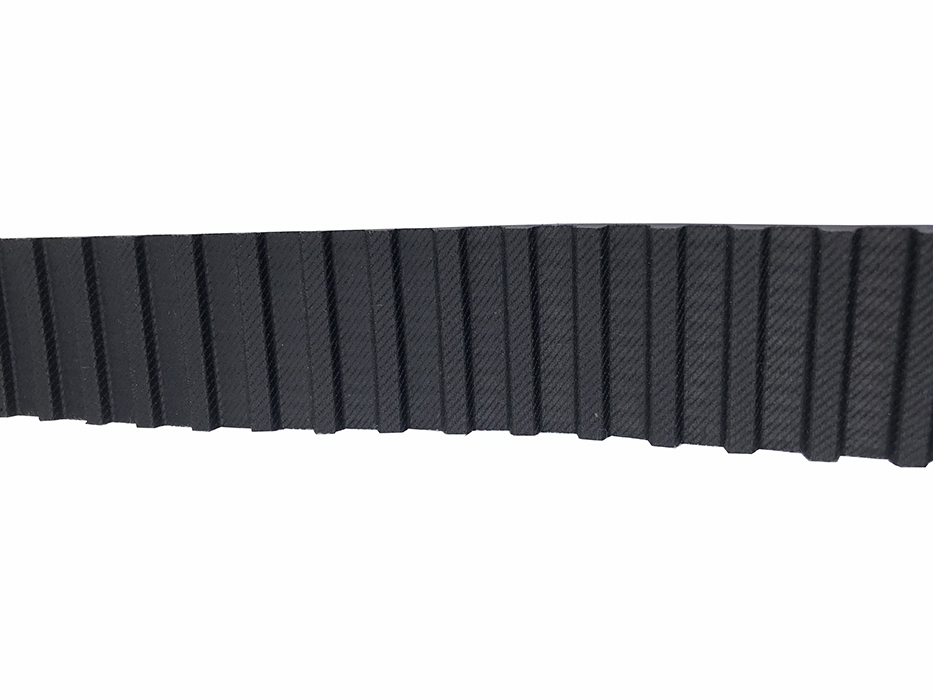
The T10 synchronous belt is built from three functional layers. The belt body is a chloroprene rubber (CR) compound, the tensile member is a high-strength glass fiber cord, and the tooth surface is protected by a specially treated nylon 66 fabric.
Belt Body — Chloroprene Rubber (CR)
The body compound uses premium synthetic chloroprene rubber (CR). HNBR compounds are available on request for high-temperature or oil-resistant applications.
Tensile Member — Glass Fiber Cord
The load-carrying cords are high-strength glass fiber cord. The cord combines high tensile strength with very low elongation, so the pitch length stays stable under load and the belt does not lose timing accuracy as torque rises. It also provides excellent fatigue resistance for the many millions of flex cycles a timing belt accumulates in service.
Tooth Facing — Nylon 66 Fabric
The tooth surface is covered with a specially treated nylon 66 high-elastic fabric. The fabric protects the tooth flank, reduces friction against the pulley grooves, improves wear resistance and helps the belt run quietly even at high linear speed.
| Layer | Material | Function |
|---|---|---|
| Tooth facing | Specially treated nylon 66 high-elastic fabric | Wear protection, low friction, quiet running |
| Tensile member | High-strength glass fiber cord | Load carrying, low elongation, pitch stability |
| Belt body | Chloroprene rubber (CR) with additives | Tooth form, environmental and chemical resistance |
Standard Specifications
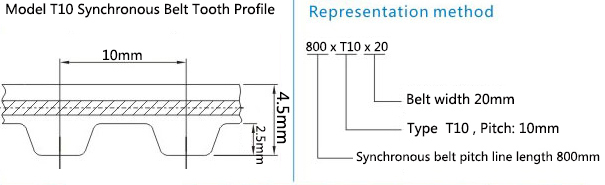
Tooth geometry is defined by a 10 mm pitch, a 2.5 mm tooth height and a 4.5 mm overall belt thickness.
| Parameter | Value | Parameter | Value |
|---|---|---|---|
| Tooth Pitch | 10 mm | Tooth Profile | Trapezoidal |
| Tooth Height | 2.5 mm | Tooth Angle | 40° |
| Belt Total Thickness | 4.5 mm | Pitch Length Range | 120 mm to 7050 mm |
| Maximum Linear Speed | 35 m/s | Transmission Efficiency | Up to 98% |
| Speed Ratio | Up to 1:10 | Power Range | Hundreds of watts to hundreds of kW |
| Operating Temperature | -30 to +90 °C | Standard Models | 231 |
| Belt Body Material | Chloroprene Rubber (CR) | Tensile Cord | Glass Fiber |
| Tooth Facing | Nylon 66 Fabric | Lubrication | Not required |
Belt Designation
A T10 synchronous belt is designated by its pitch line length followed by the belt type, for example T10x800: a T10 belt with a 800 mm pitch line length and 80 teeth (the number of teeth equals the pitch length divided by the 10 mm pitch). The same belt also appears as T10-800 or 800-T10 in some catalogues. Belt width is selected separately to suit the load to be transmitted.
Key Advantages
- Positive, Slip-Free Drive: Teeth mesh with the pulley grooves, so there is no slip and no measurable speed loss between the driving and driven shafts, giving accurate and repeatable positioning.
- High Transmission Efficiency: The T10 synchronous belt reaches a transmission efficiency of 98% or more, keeping energy losses and running costs low.
- High Torque in a Compact Drive: The 10 mm metric pitch carries a large tooth cross-section, so a relatively narrow belt handles medium-to-heavy duty loads without a bulky drive package.
- Maintenance-Free Operation: No lubrication, no tension re-adjustment and no routine maintenance are required after correct installation, and the belt runs clean without oil or grease contamination.
- Wide Speed Ratio and Speed Range: Speed ratios up to 1:10 and linear speeds up to 35 m/s are permitted, covering both slow, high-torque drives and fast, high-throughput machinery.
- Excellent Durability: Outstanding dynamic flexing performance, crack resistance and ozone resistance, together with ageing, heat and wear resistance, deliver a long and dependable service life.
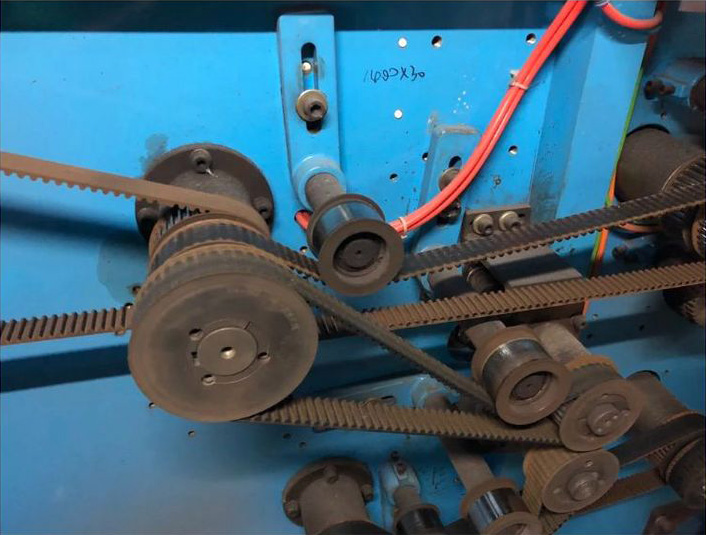
- Multi-Shaft Drive Capability: One T10 synchronous belt can drive several shafts at once, which simplifies the layout of complex machinery and reduces the number of drive components.
Applications
T10 synchronous belts are used wherever a compact drive has to transmit real torque while holding precise timing. Typical applications fall into three broad groups.
Industrial Equipment
- CNC machines, linear motion systems and automation equipment
- Packaging machinery: case sealers, labelling machines and cartoners
- Conveyor systems and material handling equipment
- Printing presses, textile machinery and food processing equipment
- Robotic positioners and indexing drives
Commercial & Office Equipment
- High-volume office printers and copiers
- Automatic door operators and elevator door drives
- Vending machines, ticket dispensers and ATM mechanisms
- Commercial fitness equipment such as treadmills and elliptical trainers
- Industrial sewing machines
Consumer & Home Equipment
- Heavy-duty home fitness equipment
- Automatic garage door openers
- Power tools and garden equipment
- High-end 3D printers and small home automation systems
Installation & Maintenance
Correct handling, installation and tensioning decide how long a T10 synchronous belt lasts.
Handling, Storage and Replacement
- Check the belt on receipt: the surface must be clean and intact, the belt must not be twisted, and the teeth must be full and well formed.
- Never bend or kink the belt: bending during transport and installation damages the glass fiber tensile member and reduces belt strength.
- Avoid damage and chemicals: do not scratch the belt, keep it away from chemicals (especially strongly oxidising acids), and avoid prolonged contact with oil and water.
- Release tension before removal: when replacing a belt, reduce the tension to a minimum before taking the belt off, and never pry it away under high tension with non-professional tools.
Installation Practice
- Never pry a belt onto a pulley: loosen the adjustable motor mount and slide the belt into place; prying damages the internal tensile cords.
- Align the pulleys: keep the driving and driven pulleys parallel to within half a degree and axially aligned, to avoid uneven wear and frayed edges.
- Set the correct tension: use a tension gauge and follow the drive manufacturer’s figure; over-tensioning shortens bearing life, while under-tensioning causes tooth jump and rapid wear.
- Inspect the pulley grooves: check for wear, burrs and damage before fitting a new belt, since worn pulleys destroy new belts quickly.
- Keep the drive clean: remove oil, grease and chemical contamination from belt and pulley surfaces.
- Re-check tension after break-in: check the tension again after the first 24 to 48 hours of running and re-tension if necessary.
- Inspect regularly: carry out periodic visual checks for cracks, fraying, tooth damage and abnormal wear, and replace the belt before a failure causes downtime.
Tooth Profile Comparison
Select the correct tooth profile for your application using the comparison below.
| Belt Type | Pitch | Typical Load Class | Primary Applications |
|---|---|---|---|
| MXL | 2.032 mm | Ultra-light precision | Small electronics, scanners, miniature motors |
| XL | 5.080 mm | Light duty | Small office equipment, 3D printers, small appliances |
| L | 9.525 mm | Light to medium duty | Sewing machines, small conveyors, printers |
| T10 | 10 mm (metric) | Medium to heavy precision | CNC, linear motion, automation, conveyors |
| H | 12.7 mm | Heavy duty | Industrial drives, agricultural equipment, heavy machinery |
| AT10 | 10 mm (metric) | High-precision heavy duty | High-accuracy positioning, zero-backlash drives |
Standard Widths & Naming
T10 synchronous belts are supplied in the following standard widths. Width is selected separately from the pitch length to suit the load to be transmitted.
| Standard Width (mm) | Common Application Load Class |
|---|---|
| 10-15 mm | Light-duty precision positioning, small automation |
| 20-25 mm | Medium-duty linear motion, small conveyors |
| 30 mm | General purpose industrial drives, most popular width |
| 40 mm | Medium-heavy duty conveyors, packaging machinery |
| 50 mm | Heavy-duty power transmission, large gantry systems |
Download T10 Synchronous Belt Complete Size Chart & Dimensional PDF
All T10 timing belts are manufactured in accordance with the ISO 17396 standard for metric-pitch trapezoidal tooth profiles (T system), ensuring full dimensional interchangeability with equivalent-profile T10 timing belts from other mainstream international manufacturers.
Inquiry & Contact
All standard T10 synchronous belt models are held in stock for fast global shipping. Custom endless belt fabrication and open-end roll supply are available for linear motion applications, together with full OEM and ODM support for custom specifications.
| Ordering Information | Detail |
|---|---|
| Model Designation | Pitch length + T10, e.g. T10x800 (see Section 5 for the full list) |
| Standard Models | 231 pitch lengths from 120 mm to 7050 mm, all available for order |
| Custom Lengths | Manufactured on request to customer specification |
| Minimum Order Quantity | 100 pcs for standard sizes, 200 pcs for custom orders |
| Packaging | Coiled, wrapped and packed in cartons on pallets |
| Delivery | Worldwide shipping; lead time confirmed at order |
Frequently Asked Questions
What is a T10 synchronous belt?
The T10 synchronous belt is a metric trapezoidal-tooth timing belt with an exact 10 mm pitch, a 2.5 mm tooth height and a 4.5 mm overall thickness. It transmits power by positive tooth engagement, so the drive runs slip-free, without lubrication and without speed variation, and it reaches a transmission efficiency of up to 98%.
What is the difference between T10 and AT10?
Both have a 10 mm metric pitch, but they use different tooth profiles. T10 is the standard trapezoidal profile, while AT10 is a modified profile designed for higher precision and near zero-backlash drives. Their tooth geometry and pulleys differ, so a T10 belt and an AT10 belt are not interchangeable.
What is the difference between T10 and XL or L belts?
T10 is a metric-pitch belt with a 10 mm pitch, while XL and L are inch-pitch belts with 5.080 mm and 9.525 mm pitches. The 10 mm metric pitch carries a larger tooth cross-section, so T10 transmits more torque in a compact drive, but it needs different pulleys and is not interchangeable with XL or L belts.
How do I read a T10 belt model number such as T10x600?
The designation is the pitch line length together with the belt type, for example T10x600: a T10 belt with a 600 mm pitch line length and 60 teeth, since the number of teeth equals the pitch length divided by the 10 mm pitch. The same belt also appears as T10-600 or 600-T10 in some catalogues.
What widths and lengths are available?
We stock 231 standard T10 models from 120 mm to 7050 mm in seven widths: 10, 15, 20, 25, 30, 40 and 50 mm. Custom widths and non-standard lengths can be manufactured on request.
What materials and construction do T10 belts use?
Every T10 synchronous belt uses a three-layer composite construction: a chloroprene rubber (CR) body, a high-strength glass fiber tensile cord, and a specially treated nylon 66 tooth facing for wear protection and low friction.
What applications are T10 timing belts used for?
T10 timing belts are used for CNC machines, linear motion systems, automation equipment, packaging machinery, conveyors, printing and textile machinery, robotic positioners, office printers and copiers, automatic door operators, vending machines, fitness equipment and power tools.
Are T10 timing belts interchangeable with belts from other manufacturers?
Yes. Our T10 timing belts are manufactured to the ISO 17396 standard for metric-pitch trapezoidal tooth profiles and are fully dimensionally interchangeable with equivalent-profile T10 timing belts from other mainstream international manufacturers.
Request a Quote for T10 Synchronous Belts
All standard models are in stock for fast global shipping. Contact our sales team for pricing, lead times and free application engineering support.
Related products: H Synchronous Belt | S8M Timing Belt | Full Timing Belt Catalog
Reviews
There are no reviews yet.